Abstract
We address the challenge of uncovering systematic, and potentially controllable, dynamical structure underlying complex high-dimensional time-series data. Existing generative and autoregressive models have difficulty telling systematic content apart from distractors, while contrastive methods struggle to learn accurate dynamics. To address these shortcomings, we develop the Recognition-Parametrized Gaussian State-Space Model (RP-GSSM), a probabilistic framework that infers accurate latent dynamics without relying on a parametrized decoder. By eliminating explicit generative parameters, the model directs its entire representational capacity to encoding dynamically relevant state; and, being fully probabilistic, learns via maximum likelihood without auxiliary objectives or ad-hoc regularization. Combining the expressive power of a neural network encoder with exact inference under a jointly Gaussian prior allows the RP-GSSM to embed a broad class of intrinsically nonlinear dynamical systems. The RP-GSSM parameters are provably linearly identifiable in the infinite data limit. We show that the RP-GSSM recovers physically meaningful latent states from noisy video more faithfully than competing methods, more reliably identifies underlying controllable nonlinear dynamics, and remains substantially more robust to visual distractors.
Figures
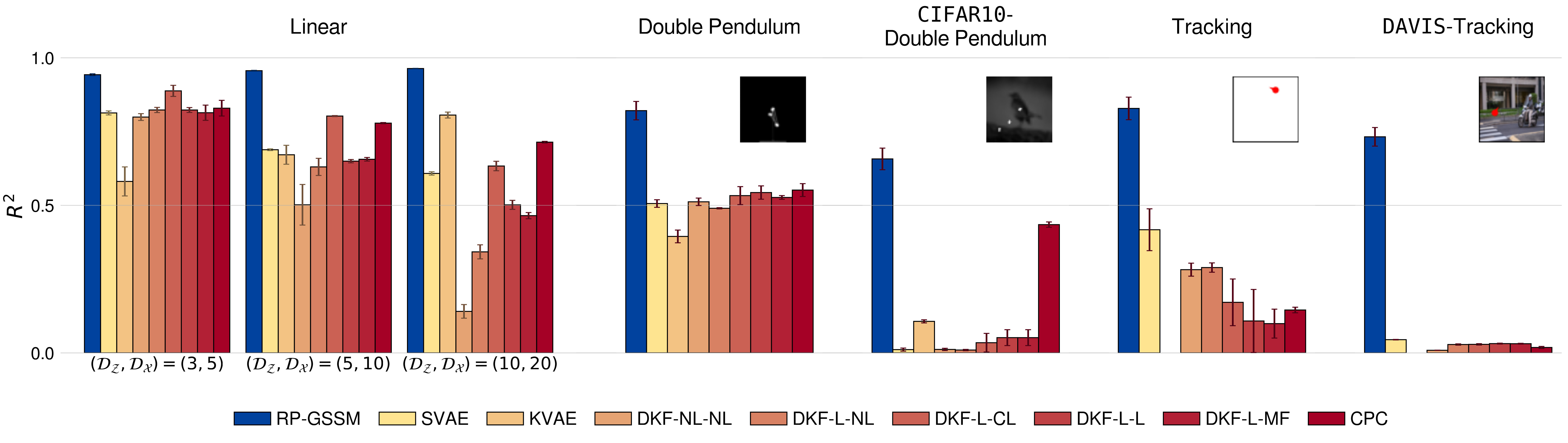
Linear regression validation R2 scores across models, on the linear, double pendulum, and tracking tasks, with and without distractors.
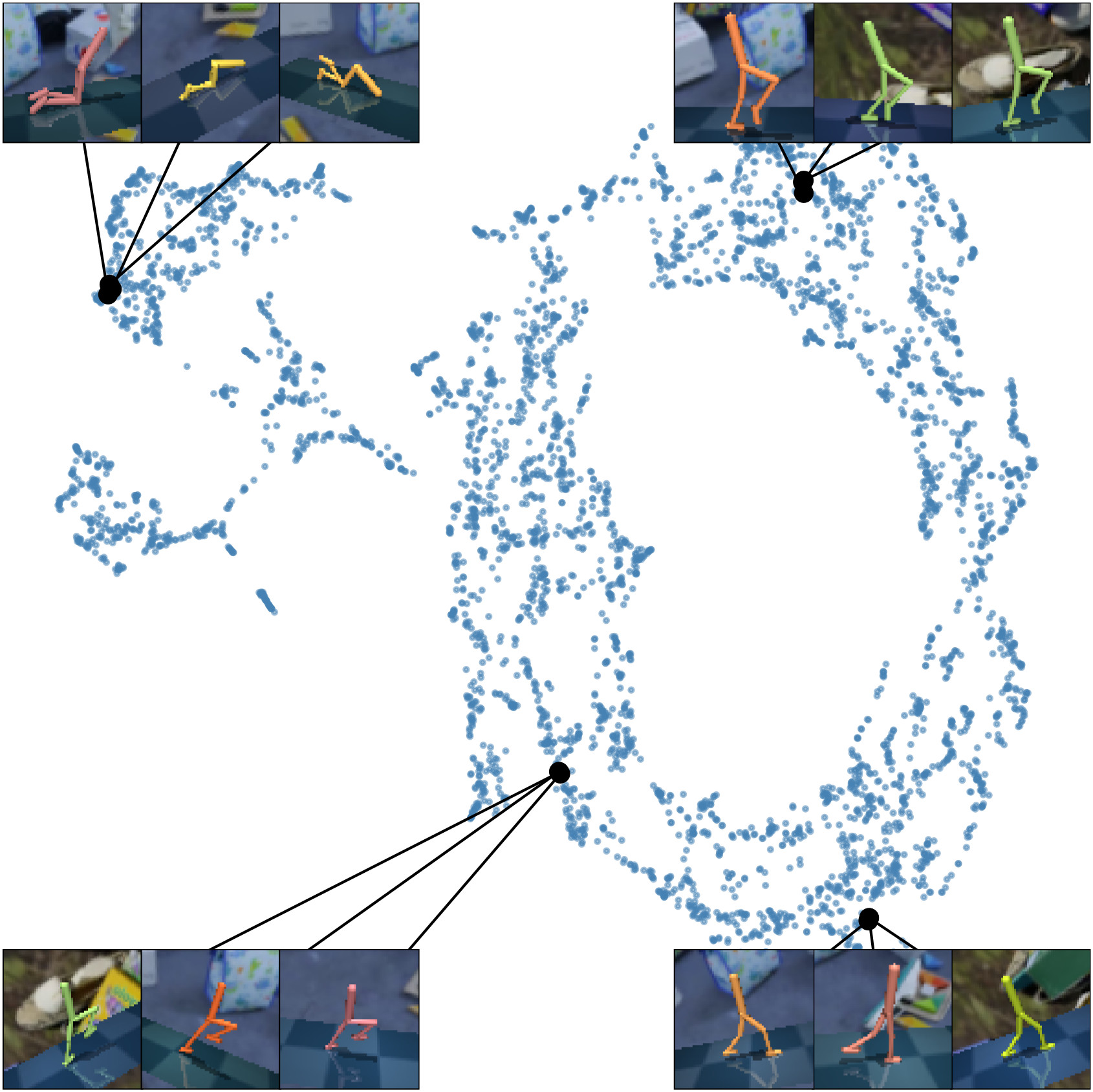
2-dimensional UMAP embeddings of RP-GSSM posterior means on the Walker environment, with four sets of representative nearest-neighbor frames.
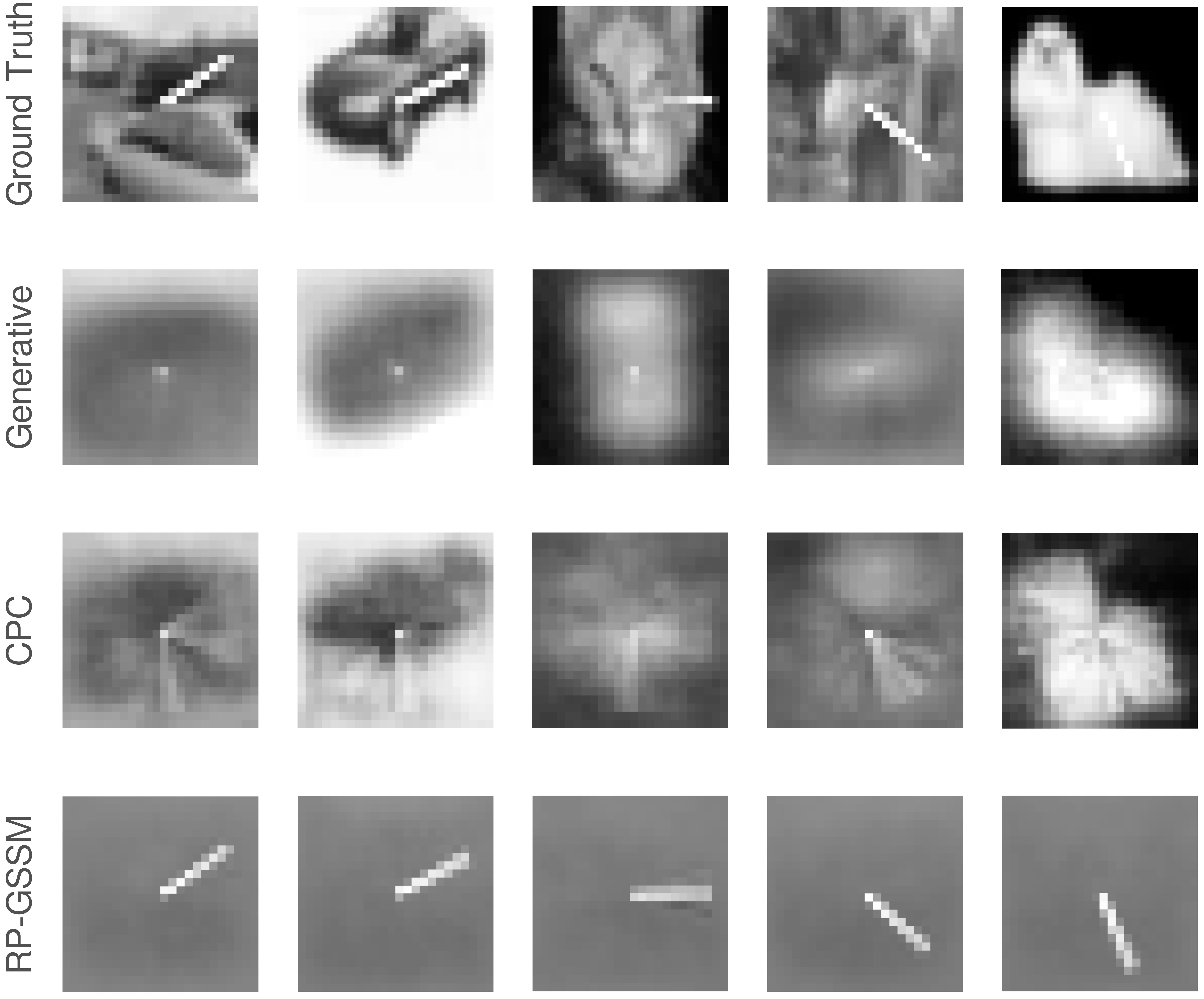
Auxiliary decoder reconstructions of the RP-GSSM, CPC, and best generative baseline on the CIFAR10-Pendulum task.
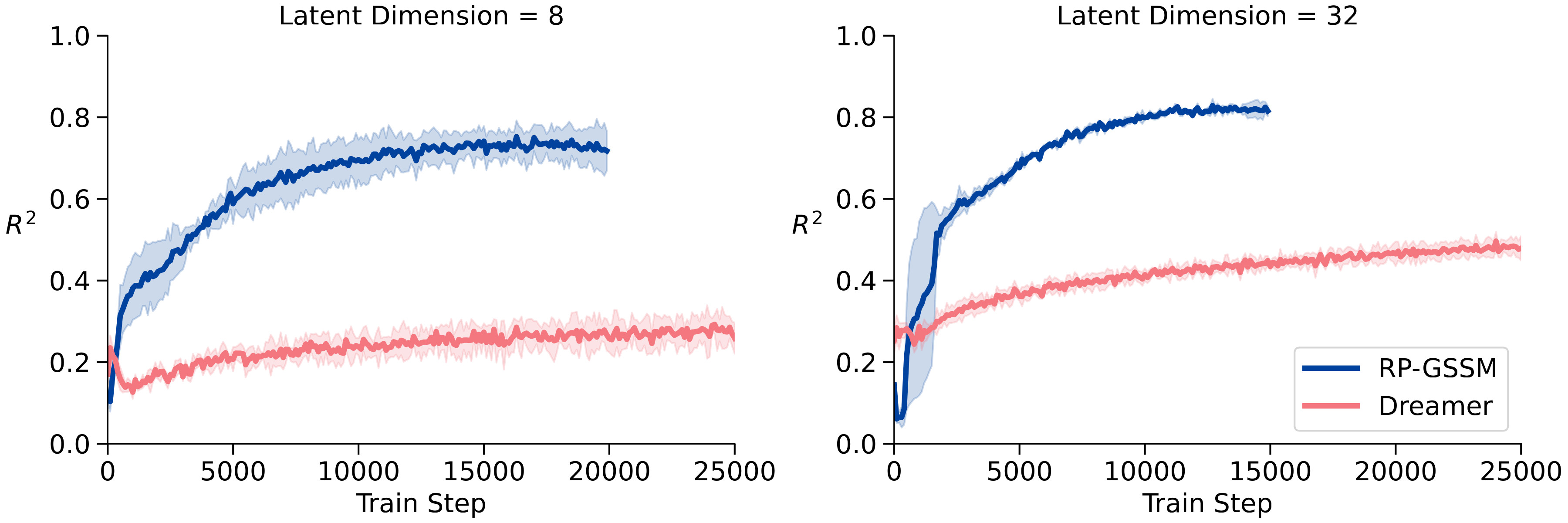
Kernel ridge regression validation R2 scores across training on the Walker environment with distractors.
Poster
BibTeX
@inproceedings{hromadka2026maximum,
  title     = {Maximum-Likelihood Learning of Latent Dynamics Without Reconstruction},
  author    = {Samo Hromadka and Kai Biegun and Lior Fox and James Heald and Maneesh Sahani},
  booktitle = {Proceedings of the 43rd International Conference on Machine Learning},
  year      = {2026},
  series    = {Proceedings of Machine Learning Research},
  publisher = {PMLR},
  address   = {Seoul, South Korea}
}